Industry Focus – Diving into a segment of The Equity Market – The Battery Segment

CHINA’S CHOKEHOLD ON BATTERY

Batteries are going to be the picks and shovels of the future business that are data driven and electrified. 5 years from now the electrical grid is going to be materially different compared to what we have today and the electrical vehicle business is going to be robust. There is increasing demand for batteries and their primary element the lithium ion. Essentially it uses the element lithium ion, to capture electrical particles and turn them to useable power.

Over the course of the next 5 years the battery segment it is well poised to grow at the rate of 10 to 15 percent sustainably over the next 10 years. In terms of where we are seeing this, different companies are tying up and recognising the importance of batteries – in June 2018 GM and Honda announced a partnership that Honda is going to buy battery modules from GM as they are looking for better performance and longer range. Like how the transportation segment revolved around the “fuel economy”, in the coming years the move is towards the “battery economy”. The better you make a battery, the better you can make an electrical vehicle – and the same is true for anything that has battery at the heart of it – data centres, grid, or even a corporate head quarters (where a lot of data is stored, power is required and the electric generator that is used are powered using advanced batteries). This is all a part of a much bigger movement, to make an effective and efficient use of electricity and how we do business in the future.

Leading up to today we see more demand for smart phones, stationary storage is catching up, but the EV’s are going to be the drivers of demand of battery (Goldman Sachs projects about 55% of the lithium ion battery market will be controlled by EV in 2020). Batteries are going to emerge as a really important part of the economy for both energy production and transportation.

What exactly is a battery?

The simplest definition can be that it is a device that is able to store electrical energy in the form of chemical energy and convert that energy into electricity. There are different chemical substances in the battery, which then exchange electrons across the battery cell which then exchange energy. The main components are the cathode the positive terminal of the battery, the anode the negative terminal of the battery and the electrolyte. The electrons flow from the anode – the negative terminal of the battery, towards the cathode – the positive terminal of the battery creating a closed circuit.

The most popular battery for all application today is the lithium-ion battery. The lithium is the martial which is in the cathode, used to exchange electrons across the system.

The lithium ion battery has become the default go-to for battery manufactures. First of all there is a fair amount of lithium available; it is very light and thin. It can hold its charge, for a substantial amount of time when compared to the lead acid or the classic alkaline battery. When you charge a lithium ion, you can be fairly secure that the charge you put in, most of it is going to stay there. The classic alkaline battery is not rechargeable, and the lead acid battery which is rechargeable, but requires constant recharging as it discharges easily.

The next question that arises is the availability and the production of lithium which can be in 2 ways – from Brian ponds predominantly from South America – Chile & Argentina. The second is from mineral rocks predominantly from China, Australia, Portugal and Zimbabwe.

The lithium is extracted through normal evaporation from Brian pond as it is the cheapest and the simplest way, but it can be time consuming. When mining it from mineral rocks, there is higher concentrated amount of lithium but it is more expensive and has environmental impacts.

CHINA’S CHOKEHOLD ON BATTERY – SUPPLY AND DEMAND

China wants to push toward cleaner energy, due to their air condition and their population. They   have weak supplies of hydro carbons such as oil or natural gas and are depended heavily on Russia and the Middle East for oil, but have a robust lithium reserve, dominating global markets. In home market lithium ion is key for EV, as it vital for them to have large amounts of native production.

China has a huge reserve of lithium; most of it is in the form of mineral rocks, for producing lithium. Several native Chinese companies are using this to their advantage and making their names in the lithium ion business. Tianqi lithium recently paid nearly $4.3 billion, to become the second largest share holder in Chile’s SQM mining company one of the largest lit aggregators and producers of lithium in the world.

China very well positioned, having a controlling stance over lithium by making investments in South America and Australia and get a big bite out the market outside China as well. They have not dived into their own reserve, as they have locked up supplies elsewhere.

Being the largest consumer of lithium as well as the producer, China really controls both the demand side as well as the supply side.

Cobalt is a very important component for a battery; it helps in maintaining the longevity, stability and safety of the battery. If we reduce the level of cobalt in the battery, we need to increase the level of nickel, which increases risks of overheating and fires. It is expensive and expected to increase in demand between 10 and 25 times from current levels by 2030 with over 50% of the demand coming from battery segment. About 2/3 rd of the global supplies comes out of Congo.

Again when it comes to Cobalt, China has a significant position controlling 8 of the 14 largest miners in the Congo. China also accounts for 80% of the production of cobalt related chemicals, the chemical required to take the metal of the ground refine it and make it useable for the battery. China’s position in cobalt and layering it on lithium, locks-in both the supply and the demand side for the lithium ion battery.

As we look at different ways to produce cathode to go with lithium anode there is a strong interest in moving away from the strong holds that China has built up reserves around. Anode is predominantly graphite, which by surprise China had around 65% of the global production in 2017. Of the cathode and anode side, China had a major presence.

In the anode side, there have been explorations, works have been going on to replace graphite with aluminium, as it can hold more lithium, but any of these technologies have not reached commercial scale right now.

Important take away from the macro perspective is that as we look out in the battery market in the next 3-5 years, it’s going to run through China.

The leading EV battery formula that’s being used right now – nickel-manganese-cobalt-oxide cathode, China controls 57 % of their production. When it comes to the significant control of the inputs lithium, cobalt, when it comes to the refining capacity of the cobalt, they have 80 % of that capacity. On top of that, having a majority share of manufacturing of the cathodes that go into the manufacturing  of lithium ion battery and over about 40% EV demand (source: IEA), IEA is projecting for China to control by 2040. When you are controlling all the steps in the value chain, from the rock coming out of the ground, all the way down to an EV driving of the lot, at least in the near term China is going to have a very important role to play.

Indrajith Aditya
Team Member – Equity Research and Valuation
(M.Sc. Finance, NMIMS – Mumbai 2018-20)
Pakistan’s Rupee Devaluation of Little or No Avail

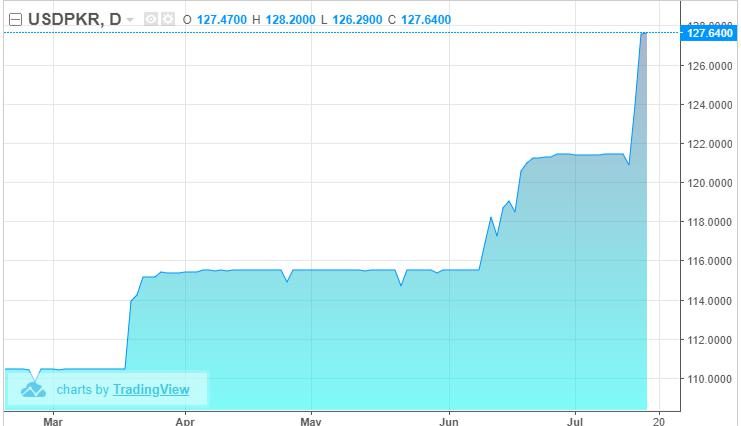
Pakistan’s fiscal and monetary conditions have only worsened in the past few years leading to the devaluation of the currency by as much as 15% YTD (2018).

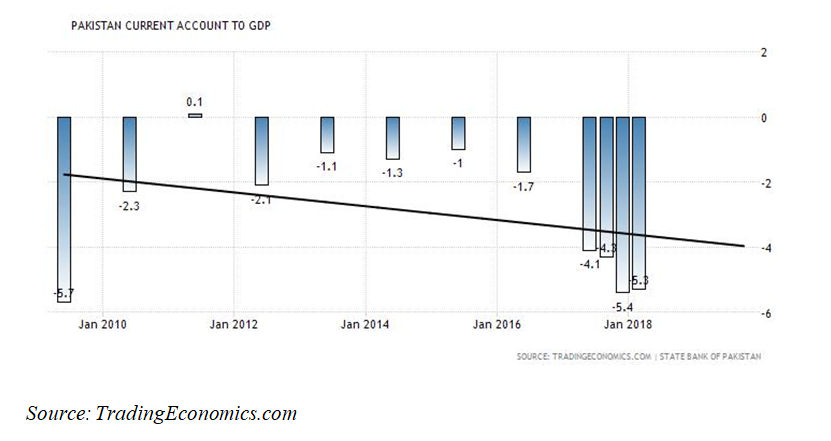
Let’s look at a few charts that matter:

When a country devalues its currency their goal is to spur export growth by making their goods & services cheaper and curtail high imports.

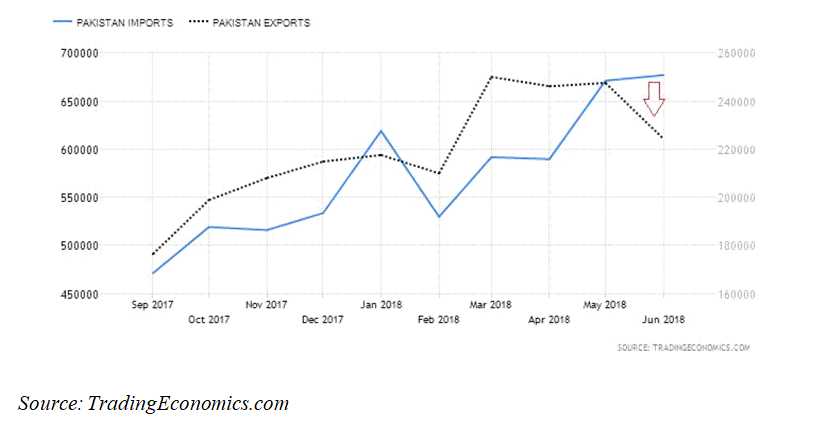
However, in case of Pakistan, the imports have remained elevated and exports have slowed down considerably even in the event of devaluation.

Post devaluing the PKR 3 times this year (2018), the imports have remained stubborn at 676 PKR billion whereas exports plunged from around 250 odd PKR billion to 224 PKR billion, down to pre-devaluation levels.

As a result, the country’s CAD or Current Account Deficit has deteriorated to unhealthy levels, the lowest since 2010.

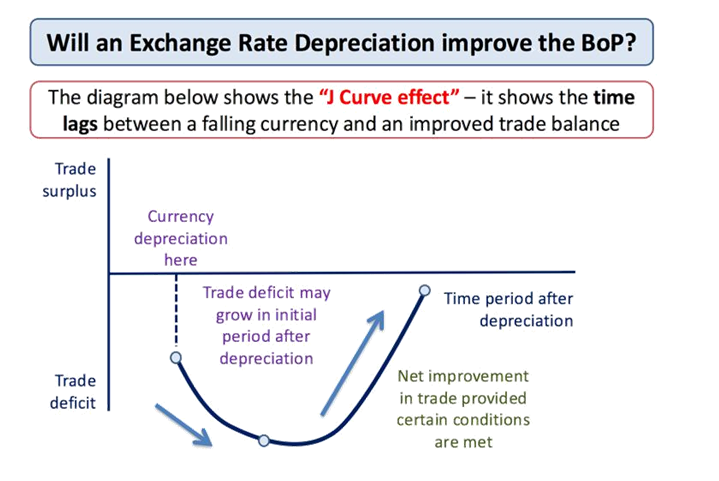
Maybe we owe this divergence in import-export to the so called Michael-Lerner Equation & the J curve effect?

The concept states that currency devaluation’s initial impact is a worsened BOP as there’s usually a lag between the pickup in exports (drop in imports) and devaluation.

The economy takes some time in order to structurally shift and realize that the imports are now expensive (so reduce them) and the exports are cheaper (so importing countries find it attractive and import more).

Whether Pakistan’s exports are still competitive considering its peers is another question.

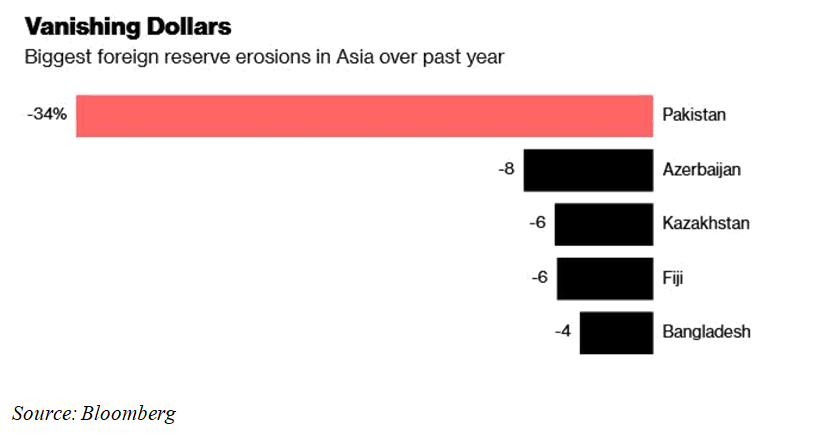
Now the natural impact of this is on the FX reserves, which have dropped sharply amid rising oil imports, lower FDI, higher debt burden, rising US interest rates and the list goes on. (with the China CPEC also putting a strain on the country’s BOP)

Here’s a chart by Bloomberg:

Although, the condition is not as worse as in Argentina, Turkey and the like where the outflows have been much higher, this is also worth noting.

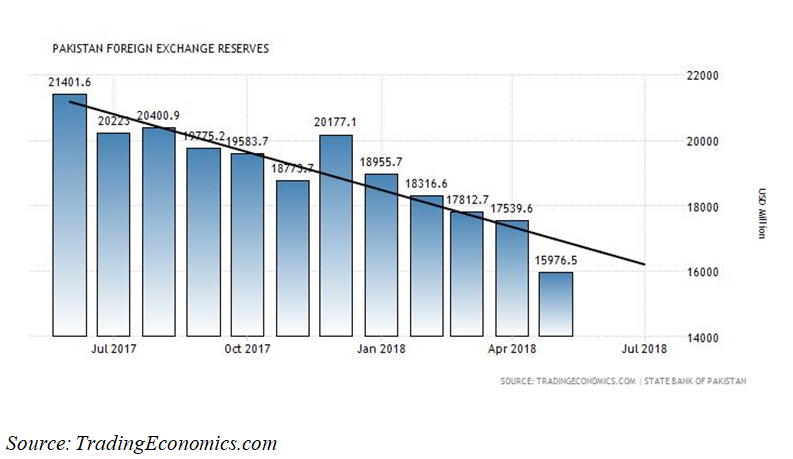
Here you can observe that the FX reserves have been declining consistently and have almost halved from their 2015 peak of around $24 billion to around $15.9 billion currently, reducing their import cover.

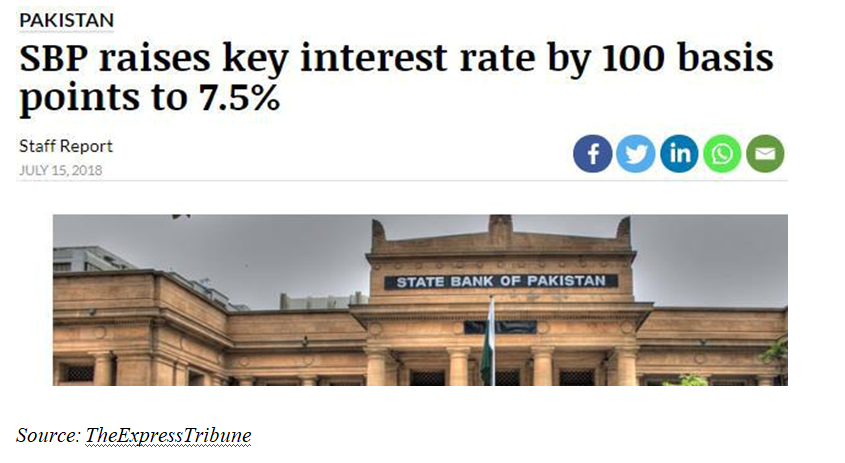
Pakistan’s real reserves have dropped below the level reached when the country approached IMF the last two times for a bailout, according to Bilal Khan, a senior economist at Standard Chartered Bank Plc. With elections scheduled for July 25, the next government will need to approach the IMF as a “matter of urgency,” said Khan. (Source: Bloomberg) This has thus, lead the State Bank of Pakistan (SBP) to hike rates by almost 100bps (175bps YTD).

Will this able to reverse the flows, reduce CAD (Current Account Deficit) and stabilize the economy with the backdrop of vanishing dollar liquidity and tightening monetary conditions across the globe? Maybe not.

Will we look at an International Monetary Fund (IMF) bailout? IMF is largely influenced by the US and with the on-going tensions between Washington and Beijing; an IMF bailout will be a less likely option for Islamabad.

President Trump probably believes that it would not be in the interest of US tax payers (whose money is being used to fund the IMF) to bailout the Chinese bond holders who have lent money to Pakistan for their ambitious BRI (Belt & Road Initiative) and CPEC (China Pakistan Economic Corridor) projects.

Author
Harsh Shivlani
Team Leader– Fixed Income & Derivatives
(M.Sc. Finance, NMIMS – Mumbai. Batch 2018-20)

Connect with Harsh on LinkedIn

Artificial Intelligence in Finance: A Genesis

Artificial Intelligence (AI) started as the branch of computer science that aimed to make the computers follow logical steps to do some of the basic functions that the humans perform using common sense and has evolved from imitation, extension, augmentation and finally aims to reach human-level AI. In 1956 John McCarthy used the coinage ‘Artificial Intelligence’ and proposed a summer research project on the subject at the Dartmouth college involving scientists of psychology, mathematics, computer science and information theory; marking the beginning of AI as a science and engineering of making intelligent machines and recognizing it as a field of research. Technologies driving AI have since evolved from conventional programming using logical steps, heuristics using neural networks, machine learning using big data analytics to the ability of self-evolution. As a part of AI, machines simulate human intelligence processes like learning (acquire information and the rules for using that information), reasoning (using rules to reach approximate or definite conclusions) and self-correction to find application in expert systems, speech recognition and machine vision.

Kai Fu Lee classifies AI revolution in four waves. The first wave was the internet AI which began about 15 years ago but matured around 2012 and was mostly about using AI algorithms as recommendation engines. Some of the common applications of these are in recommending streaming videos in YouTube and likely next purchase on Amazon. Many users find internet experience getting better and becoming addictive often because of a successful AI recommending algorithm working in the background. Companies like Google, YouTube, Baidu, Amazon and Alibaba made substantial financial gains using internet AI. Another major application of internet AI is in using algorithms as editors giving real time news that is customised to a user, digital reporter and a virtual robot cop that reports fake news.

The use of neural networks, Deep learning and Machine learning in financial services has recently exponentially gone up, with there being “Robo-advisor’s”, such as “Wealthfront”. Traditional financial advisors have high fees, minimum account balances etc. However, in “Wealthfront”, they use risk assessment algorithms to ascertain risk and create highly individualized plans. The created portfolio is also continuously monitored and periodically churned to give the highest return.

The use of neural networks is also used to find cointegrated pairs for pairs trading. As after implementing a rolling Beta, the pair which was once cointegrated for a time period might not be so in the future and might not mean revert. And using machine learning on previously cointegrated pairs that stopped mean reverting.

Even Bank Of America Merril Lynch is implanting enterprise software fintech HighRadius’s Artificial Intelligence solution to speed up stock receivables reconciliation for the banks big business clients. While, some might look at Artificial Intelligence as a path to a brighter future with greater efficiency. There are others like Elon Musk, who refer to the future of Artificial Intelligence as an “immortal dictator”. This might sound hypocritical of him as he created an AI that defeated some of the best DOTA 2 players in the world. This is one of the greatest milestones that AI has ever crossed. IBM’s Deep blue computer defeated one of the best chess players in the world Garry Kasparov in 1997. And In 2016, AlphaGo defeated Lee Se-dol at the board game Go. This further pushed China to peruse AI as the board game GO which was the pride of China.These fears regarding AI are not applicable to the use in Finance; As they are not true while using “narrow AI”, such as in Financial Services.

The second AI wave was the business AI, that makes use of legacy systems data that was already being labelled and stored by traditional companies like the insurance companies covering data on accident claims and frauds, banks on loans and repayment rates, hospitals on diagnosis and survival rates etc. and structured corporate data like historic stock prices, credit card usage, mortgage defaults etc. Early instances of business AI have clustered heavily in the financial sector because it naturally lends itself to data analysis since it runs on structured information and has a clear metric that needs to be optimized. AI, therefore, is ideally applied for optimization for maximisation of the bottom line.

AI finds application in computational finance where an automated intelligent agent is applied for pattern recognition and use it to discover patterns in the stock prices for accurate prediction. Although major companies like Palantir and IBM offered big-data consultancy since 2004, major capabilities in the field emerged after the adoption of deep learning in 2013. Companies like Element AI of Canada and 4th Paradigm of China entered the competition offering algorithms that could mine the data of traditional companies and organizations to improve fraud detection, make smarter trades and uncover inefficiencies in supply chains to use AI for cost savings and profit maximisation.

Whilst there are several credit cards and mobile payment applications that are popular and prevalent, their core services limit spending. An AI powered micro finance app called Smart Finance in China relies exclusively on an algorithm to make millions of small loans. The deep learning algorithm uses a wide range of information including offbeat information like the speed at which the user types his date of birth or the amount of battery power left on the phone etc. of the user from his mobile to predict the repayment potential and authorise loans. In late 2017 the company was making more than 2 million loans per month with default rates in low single digits which outperform many traditional brick-and-mortar banks because it targeted a large user base of potential micro-finance seekers that was ignored by the traditional banking sector – the young and the migrant workers.

The other major applications in the second wave of AI are the use of algorithms for expert medical diagnostics and for legal advice to the judges based on deep learning. The 3rd AI wave is the perception AI where the distinction between the real and the virtual world are being increasingly blurred and digital assistants and Augmented as well as Virtual Reality applications are being introduced. The 4th AI wave is about autonomous vehicles like self-driving cars and autonomous robots to be employed in workplaces. The 3rd and the 4th waves are still in emerging phases but are fast expanding.

Author
Neil Jha
Team Leader – Fintech
(M.Sc. Finance, NMIMS – Mumbai. Batch 2018-20)

Connect with Neil on LinkedIn

WHY ASIAN PAINTS?

A Company Analysis Report

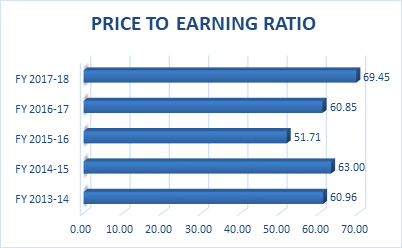
Asian Paints Ltd., the leader of the Paint & Varnish industry trading at CMP 1400 (as on 07/02/2019) has been one of the most attractive script for the investors. Despite being trading at a Price-to-Earnings Ratio of 69.45 (whereas industry’s P/E is 44.72), the investors and broking houses are bullish about the performance of the market leader of the Paint & Varnish Industry. Having seen the performances and investors’ action against the traditional market policies over the past few years makes Asian Paints an interesting case to analyse.

 ABOUT THE COMPANY

Asian Paints Ltd. is one of the most prestigious company which has been present in the market for over 75 years and having a group revenue of over USD 2.5 billion p.a. Built on the principles of providing a distinct service of paint solutions and kitchen & bath segment through constant innovation & diversification. The company works towards providing exceptional spectrum of Inspiration-Customisation-Execution service to its customer base. The company is the largest supplier in the market having nearly a significant 55% of the market cap of the country due to its conscious effort of building customer relations over the years.

PAINT INDUSTRY ANALYSIS

Asian Paints has been able to capture more than half of the market over the years. The direct competitors for Asian Paints in the market are Berger Paints India Ltd, Kansai Nerolac Paints Ltd & Akzo Nobel India Ltd. However, none of the companies has achieved the scale & diversity and the market cap as Asian Paints has over the years. The whole of Paint Industry has witnessed a steady cumulative growth of 7% Y-o-Y over the course of last 5 financial years. While Asian Paints has been able to outperform the industry and has posted a significant 10% Y-o-Y growth in the similar period surpassing the global growth trend as well as Indian growth trend of 3.7% and 6.9% respectively. With the kind of economic and infrastructure growth and development the country has been witnessing over the years which has laid the platform of the scope of development and prospect of future opportunities. This has provided a positive outlook to the industry as a whole.

STRATEGIC PLANNING- PRODUCT LINE & GEOGRAPHICAL SEGREGATION

The company’s product profile is mainly made up of paints & home improvements. It majorly consists of interior & exterior paints, wood finishes range, wall coverings, SmartCare waterproofing products, bath fittings, kitchens and wardrobes. Rainwater harvesting and water conservation schemes are also an area company is looking to expand on. The company has installed capacity of 12 lac KL p.a. in a total of 9 factories across India. Asian Paints has a very diverse consumer base ranging from housing homes to automobiles to hospitals to factories to corporates across the length and breadth of the country leading to large product portfolio. Asian Paints has separate store network in town to cater to their demands, flagship multi-category décor stores as well as dealer run painting service to provide the bouquet of products and services up on offer. The company has its presence on Global level with mergers with PPG Industry Inc, USA, Berger-Asian in the South East Asian countries, as well as newly acquired tie-ups in Sri Lanka, the Caribbean nations & Africa.

FUTURE PLANS

There are two huge factories being set-up by the company in Mysuru & Visakhapatnam with a combined installed capacity of 11 lac KL p.a. This is a clear positive indication by the company about their future plans and growth prospects. In the recent financial year out of Rs. 1350 crs of CAPEX, Rs. 1100 crs was attributed to set-up of these new plants. Being the flag bearer of the industry, the company focusses on providing premium paint solution through constant innovation via new technologies, innovation & solutions and that has been seen through growth of Research & Development. Dream home concept, Colour ideas, personalised virtual home re-imagined solution on the electronic devices with technical assistance are the ways company has imagined and planned to moving ahead in the period.

FINANCIAL ANALYSIS & PROJECTION

  • Asian Paints, being the market leader is setting trends and benchmarks for the other companies. The company with all its expansion and diversification plans combined with the future opportunities is expected to grow at a rate of approx. 12% p.a.
  • The Goodwill and reputation earned by the company in the market over the years is been reflected in its ability to maintain a highly efficient working capital cycle which indicates that it has been able to negotiate the deals and form credit policies effectively leading to quick conversion of cash back into the company. This trend is expected to be continued in the upcoming years and the net cycle is expected to be near 15 days.
  • Despite of the expansion and diversification in the recent years and the plans for the upcoming years which has seen a large amount of capital expenditure being incurred, the Fixed Assets turnover ratio is expected to tick on the positive side marginally at 5.5 because of the company’s ability to generate the additional sale from the increased expenditure.
  •  Asian Paints has both secured as well as unsecured loans though of nominal amount. The interest cost hence incurred is negligible which allows the company to plough back its profits either to its shareholders or back into the business and are not flown out of the business.
  • The company as it seems won’t be in need of additional funds either in form of equity from the shareholders or as debt from other financial institutions. At the projected rate with the current capital, Asian Paints will be able to double its current Reserves & Surplus as well. 
  • The Operating Expenses are assumed to be constant going ahead and no major change is expected in the current levels of expenses.
  • The company has a huge amount of Cash reserves and surplus which can be used going ahead in the future which can be an alternative for external debt or dilution of shares when the need arises. The cash at hand consolidates the company’s strong position in the market and industry.

COST OPTIMIZATION

Asian Paints as the flag bearer of the industry and as benchmark standards have taken many steps in order to optimize cost and use of the resources. Measures such as reduction in specific electricity consumption, use of non-product fresh water consumption, water replenishment, reduction in specific hazardous waste disposal and electricity from renewable sources have been taken up by the company.

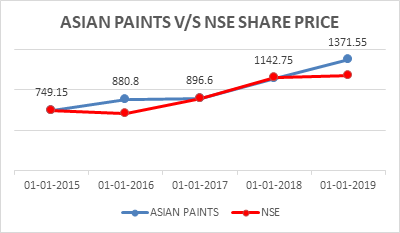
Asian Paints Ltd. has seen its share price almost doubled over the course of five years beating the benchmark average of Nifty 50. The company has seen a hike in the share price Y-o-Y in all the previous years. This has set a positive outlook for the upcoming years as well.

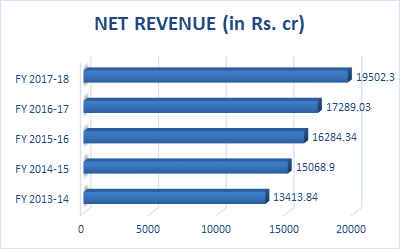
The company has revenue growing at Y-o-Y at a CAGR of 11%. This trend is expected to increase in the upcoming years with new opportunities in the current segment of the company with the expected revenue to grow at a much better rate which has been seen the results of first 3 quarters of FY 2018-19.

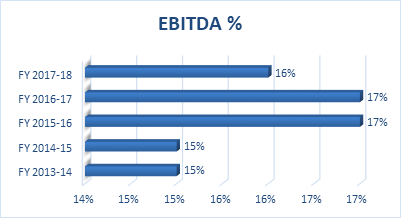
The EBITDA margins has seen a rise over the years and are expected to maintain and further continue this trend upwards till 18% which in comparison to the industries is pretty healthy. This indicates that the company is operating in a systematic manner over the years and is been able to replicate its performance despite of some uncertain events.

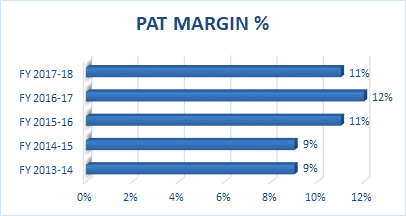
The company is quite comfortably able to churn the Operating Profit (EBITDA) into Shareholder’s earnings (PAT). This in turn indicates that the funds deployed by the shareholders are effectively been converted back to profits on a consistent basis which trend looks set to continue in the near future as well.

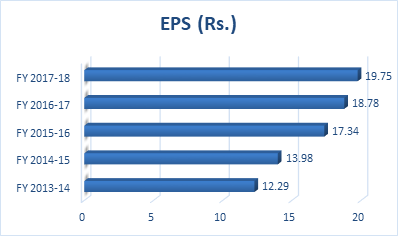
The Earning per Share of the company has increased over the period in line with the Sales of the company indicating that the rise in revenue is been reflected in the Net Profit. The company has even paid a fair share of this earning back to the shareholders in the form of dividends constantly.              

Asian Paints Ltd has had the highest P/E ratio in the industry throughout the years and still has managed to grab the investor’s interest over the years due to its fragile strength and capacity to dominate the current market with the Y-o-Y return generating capacity with the security of the investor’s funds. Hence commanding a huge premium on its price.

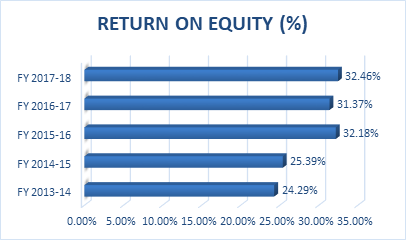
Asian Paints has been constantly able to generate a very high Return on the Shareholders funds deployed by them. An increasing trend in this percentages shows the efficiency of this almost debt-free company which is able to return the large chunk of profits back due to presence of negligible amount of debt on their books of accounts.

CONCLUSION

The fact that the company has been highly overvalued as on date by almost 270% as per projections and still is a hot-pick amongst investors and broking houses is well justified by its financial results and future prospects. With the real estate development, road network development, The SmartCity Project, Rural development combined with the Pradhan Mantri Awas Yojana (2024), Housing for all scheme and many more upcoming projects opportunities, Asian Paints being the market leader of the industry is expected to have a potential exponential comparative growth in the upcoming years ahead. The company also has a good dividend track report and has consistently declared significant dividends for the last 5 years providing the investors with return back year-on-year combined with the capital appreciation has led to a return greater than the market return.

Author
Dhrumil Wani
Team Leader – Equity Research & Valuation
(M.Sc. Finance, NMIMS – Mumbai. Batch 2018-20)

Connect with Dhrumil on LinkedIn


Empirical Study of Credit Rating versus Credit Spread

Government bonds are subject only to interest rate risk. However, corporate bonds are subject to credit risk in addition to interest rate risk. Credit risk subsumes the risk of default as well asthe risk of an adverse rating change. In this empirical study, we analyze credit rating migration versus yield spread of the bond in US corporate bond market to bring about greater understanding of its credit risk.

DATA

The data for this study consists of ratings of the corporate bonds of US corporate bond market given by S&P Global Ratings and credit spread mentioned under description of the security on the Bloomberg Terminal.The sample consist of 15 corporate bonds issuer companies which have defaulted.

LIMITATION OF THE DATA

Small sample size (Representative Bias)- The sample size for the study is limited to 15 instances of corporate bond default and hence the conclusion cannot be generalized.

METHODOLOGY

One data set focused on the latest available spread of the defaulted US Corporate Bonds. Second data set focused on the before and after credit rating of those defaulted bonds. Both data sets were studied in comparison to figure out which set of data was more predictive of default.

One data set focused on the latest available spread of the defaulted US Corporate Bonds. Second data set focused on the before and after credit rating of those defaulted bonds. Both data sets were studied in comparison to figure out which set of data was more predictive of default.

RATINGS AND ITS DESCRIPTION

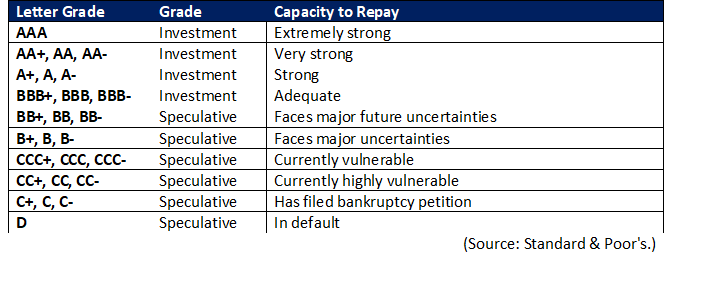
Following rating grades by Standard & Poor’s are used for analysis:

CREDIT RATING v/s CREDIT SPREAD FOR US DEFAULTED CORPORATE BONDS

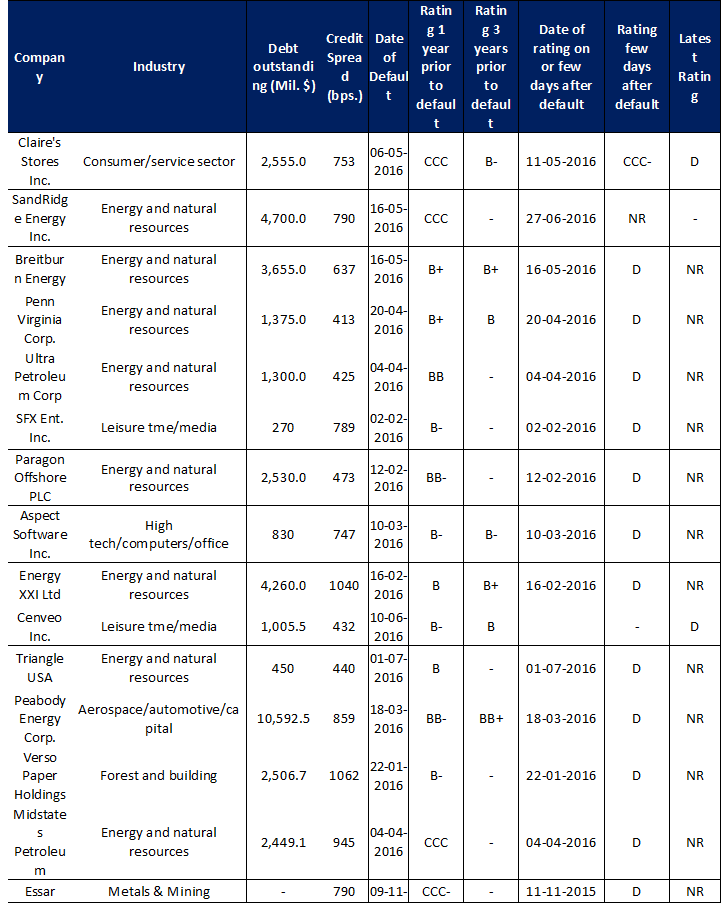
Following table shows the changes in credit rating and latest credit spread of sampled 15 corporate bonds which defaulted for either of the reasons mentioned as under:

  1. Missed interest or principal payments: 33% of the sample
  2. Debt/distressed exchanges: 20% of the sample
  3. Chapter 11 and Chapter 15 filings–along with foreign bankruptcies—together: 40% of the sample
  4. Unknown: 7% of the sample

OBSERVATION

The sampled data set reveals that:

  1. All defaulted corporate bonds have the credit spread of 400 bps or more
  2. The ratings of 75% of the bonds were changed to D (Default) on the day or within few days after its default
  3. All the Ratings lie in the ‘Speculative Grade’ defined by S&P Ratings
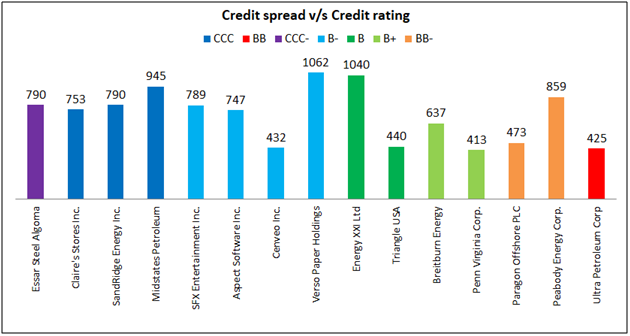
  4. Following table summarises the data of credit spread (in bps) and credit ratings of the respective sampled bonds. From blue to red bands, the credit rating decreases. Therefore, red signifies that even though the bond rating was relatively better, the bond defaulted 

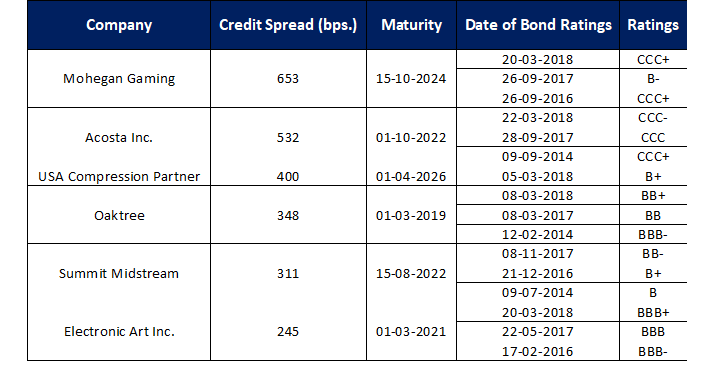
CREDIT RATING v/s CREDIT SPREAD FOR CURRENTLY TRADED U.S. CORPORATE BONDS

From the observation of historical defaulted bonds, it can be said that bonds with wider credit spread are most likely to default. Using these findings for currently traded U.S. corporate bonds mentioned in the above table, it can be concluded that Mohegan Gaming and Acosta Inc. may default. (As on 3/29/2018)

Author:
Durga Jadhav
(M.Sc. Finance, NMIMS-Mumbai
Batch 2017-19)

Connect with Durga on LinkedIn

Co-Author:
Gauri Gotaphode
(M.Sc. Finance, NMIMS-Mumbai
Batch 2017-19)

Connect with Gauri on LinkedIn

Should I Invest In Mutual Funds or ETF’s?

It’s an age long debate as to which is considered to be better in terms of an Investment Avenue. While both happen to be reasonably good options, due to its inherent nature, a lot of times ETF’s and Mutual Funds can be used interchangeably. In reality however, it is important that these asset classes have their own nuances that make them inherently different. In our innaugral post at Finvert, we will break down how these two securities are different and what are the things an investor should consider whilst investing in any one of the two.

What are ETF’s (Exchange Traded Funds)?

As the name suggests, an ETF tracks a particular index and allows the investor to buy the entire index as it were a stock. An ETF is therefore listed on an exchange and requires a Demat account for buying and selling of the fund. This lead to the name, ‘Exchange traded fund’. Due to this, ETF returns do not significantly vary from the overall market performance. ETF’s makes an ideal investment opportunity for Investors looking to beat inflation and expecting standard market performance based on historical data. The main attraction of an ETF is an overall lower turnover and expense ratio. These factors have contributed to high popularity enjoyed by ETF’s in the U.S. but not so much in India. The size of ETF’s in India seems poultry when compared to the AUM (Asset Under Management) of the countless mutual funds on offer in the market right now.

What are Mutual Funds?

Mutual Funds are a collection of a pool of money from different investors creating a fund which is actively/passively managed by a fund manager whose primary aim is to beat the returns offered by the stock market. Mutual funds can invest in various securities including stocks, commodities or bonds. A fund manager routinely changes the asset composition multiple times in a year so as to get the desired returns. This means higher turnover and hence, high expense ratio. Price is calculated daily at the end of the day based on fund performance. The entire money invested is then converted into units and sold for money.

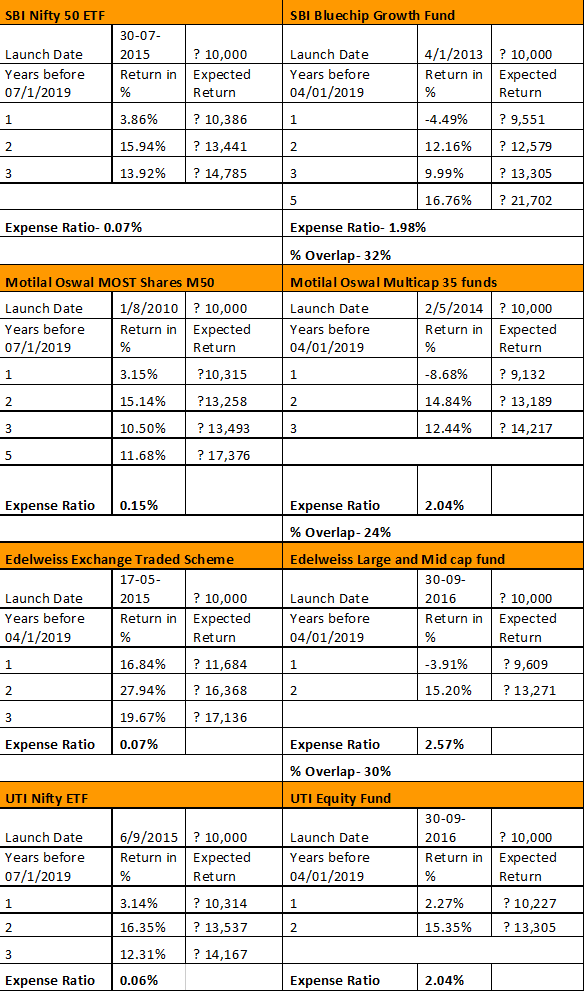
Mutual funds have burgeoned in terms of popularity in India due to the fantastic returns offered by the same in the past few years. Here we have taken some of the high performing ETF’s and Mutual funds of well-known fund houses and analysed the fund on various factors which include its returns, the expense ratio, percentage of stocks that are overlapping, etc. For a more like-to-like comparison, an ETF and a large-cap mutual fund is selected from the same fund house. Likewise, five ETF’s and five mutual funds are selected for the purpose. The returns calculated are rolling returns and also states the expected amount return when 10,000 are invested in the said scheme. 

Comparing a year’s return between securities is too short a term to perform a comparison. A three or a five year term is enough time to perform a comparison. Looking at the table, the most important distinction between the two is expense ratio. Where mutual funds generally charge anywhere around 1.75-2.5%, ETF’s get away with 0.05-0.15% as commission charged due to its passive nature. Add to that the turnover ratio (number of times stocks are bought and sold) of a mutual fund is high which also increases the overall expenses of the mutual fund. Things become interesting when tax comes to picture. Essentially, mutual funds are taxed yearly whereas capital gain tax on ETF’s can only be taxed when they are sold.

Overlapping of stocks in the security portfolio is another interesting thing between an ETF and a mutual fund. For eg., ICICI Prudential Nifty ETF and ICICI Bluechip fund direct growth have 74% of the stocks in their kitty that are similar. So ideally the returns for the same should match to a certain extent and that is very much the case for a 3 year period. But the mutual fund at 15.77% still manages to outperform ETF at 12.91% in the long term five year period. Another

The most important purpose of any investment is the returns generated and this is where mutual funds outperform ETF’s most of the time. The return is high but when factors such as expense ratio, stock turnover and tax come to picture, both the securities seem to offer similar returns. In some cases, ETF’s actually outperform mutual funds which question the whole idea of alpha generation in mutual funds in the first place.

While all this may look like a good picture for ETF’s, the reality is that ETF’s fail miserably in one important factor for any investor viz. which is liquidity. While mutual funds have grown to be very popular in India, ETF’s are very new and minuscule in comparison. So whilst the buying aspect may not be a problem, selling an ETF might be. So the investor needs to be cautious of this fact beforehand. But this being the stock market, no word is absolute and so both the options are to be considered by the investor while looking for an asset class to invest in.

This is not to be considered financial advice in any manner. Do your research before investing in any of the mentioned assets. Our work is limited to educating our readers regarding the same.

Kartik Tripathi
Forerunner- Finvert
(M.Sc. Finance, NMIMS – Mumbai 2018-20)
Ashish Tekwani
Forerunner- Finvert
(M.Sc. Finance, NMIMS – Mumbai 2018-20)